History of Pluto in Aquarius
- taylorwright1503

- Jul 29, 2025
- 5 min read
Updated: Feb 26

What does Pluto in Aquarius represent?
In world astrology, Pluto in Aquarius symbolises long-term transformation of collective systems. Pluto is associated with power, control and rebirth whilst Aquarius governs institutions, networks and technological progress.
Combined, this transit correlates with the reconstruction of societal groups, including political systems, reform movements, scientific movements and communication infrastructures. Power shifts away from centralised authority (Pluto in Capricorn) towards ideological movements, technological networks, or collective governance (Pluto in Aquarius).
Under this transit, the concept of the "collective" becomes contested, it intensfies radicalisation, ideological factions and power struggles within reform movements.
Historically, Pluto in Aquarius aligns with periods of systemic pressure, revolution, innovation and social reorganisation. It escalates debates around equality, decentralisation, surviellance and information control. In 2026, we are already seeing this with digital ID in the United Kingdom and social media bans for under 16s in Australia, for example. While it often brings scientific breakthroughs and humanitarianism, it also exposes ideological extremism. Ultimately, this transit transforms how power operates societally: these structural changes will define generations.
Pluto takes approximately 248 years to travel through all 12 zodiac signs. It takes anywhere from 12 to 31 years to transit one zodiac sign with an average of around 20 years. Below are the past years that Neptune was in Aries and the current transit:
Previous Transits: Current Transit:
795-819. 23rd March 2023 - 11th June 2023.
1041-1063. 21st Jan 2024 - 2nd Sept 2024.
1286-1308. 19th Nov 2024 - 9th Mar 2043.
1532-1553. 1st Sept 2043 - 19th Jan 2044.
1777-1798.
*Pluto was discovered a relatively short time ago in February 1930 so the transits before this happened before we knew the planet existed.
795-819: The Early Middles Ages (Carolingian Era)
Coronation of Charlemagne (800 CE): Pope Leo III was crowned as the "Emperor of the Romans". This united Western European powers with the Church and led to the establishment of the Holy Roman Empire: it marked the restoration of a Western Emperor. This signified a new imperial system and a transformational "rebirth" (Pluto) of Rome in a new ideological form (Aquarius).
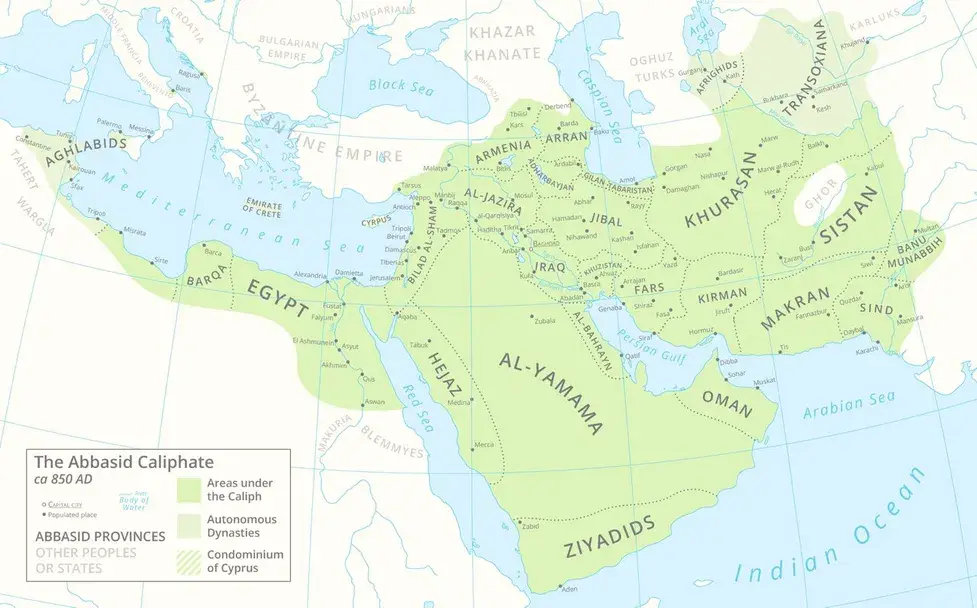
The Abbasid Civil War (811-813): this was characterised by conflict between Caliphs Al-Amin and Al-Ma'mun, this lead to the fracture of the Abbasid Caliphate. This was symbolic of ideological fragmentation and restructuring of empire and the administrative system.
1041 - 1063: The Early High Middle Ages

Pluto in Aquarius alongside Neptune in Aries like 2025-2039: this period brought many conflicts and disputes between the Eastern Orthodox and Roman Catholic Churches. Over in China, the Moveable Type was invented, these were reusable blocks used to print which allowed elements of a document to be reproduced.
The astrolabe invented: this originated in Islamic countries and India but then spread into Europe. This was an astronomical device used to determine the time and the planetary positions. Used since ancient times, it was essentially a portable star chart and a manual computer for astrologers.
1286 - 1308: The Late Middle Ages

Trade routes expanded from Eurasia into Europe (1286-1308): known as the Silk Road, this route allowed goods, technologies and ideas to travel between the Eastern and Western world mainly via China and the Middle East. These routes covered both land and ocean and influenced the development of civilisation.
Italian inventor Salvino D'Armato deli Armati invented the first spectacles (1290): these were used mainly by monks and scholars for reading. The earlier invention of the Moveable Type led to the more advanced block printing style across Europe, however this was imported from China.
The English Common Law codified by Edward I (1292): royal courts and the national legal system were both developed around this time. However, his reign notably came with conflict between the English and Scottish.
1532 - 1553: The Renaissance and Reformation Era

The Transatlantic Slave Trade began: however, the first African slaves were brought to the 'New World' during Pluto in Capricorn in 1525. Significantly, Neptune was also in Aries as it is today. This was a horrific transportation of around 12 million enslaved Africans to the America's over a 400 year period. In the early 1530s, the Spanish invaded the South American Incan Empire and obliterated their culture.
John Calvin began his Protestant reformation (1532): this aimed to reform the Catholic Church in France and establish Protestantism as the main branch of Christianity. This ultimately disappointed the Catholic Church and led to religious and political discontent and the disapproval of the Pope's authority.
Henry VII dismissed Pope Clement VII (1533): he established the Church of England so he was able to marry Anne Boleyn. In 1536, the monasteries were dissolved and Henry VII seized there assets, this led to many conflicts between the Protestants and Catholics.
Nostradamus began making predictions (1547): he published astrological almanac's starting annually in 1550. However, his first published prophecies was not published until 1555 in his book 'Centuries' under Pluto in Pisces.
1777 - 1797: The Enlightenment Era

Uranus was in Gemini as it is currently: in Russia, Catherine the Great began her reign during Pluto in Capricorn in 1776, however she ruled until 1796. As the Enlightenment era peaked, she made several reforms and she supported the arts and sciences.
The American Revolutionary War (1775-1783): this was fought due to opposition over British attempts to exert greater control over colonies. American gained independence from England during Pluto in Capricorn in 1776. However, this war ended during Pluto in Aquarius in 1783 with the Treaty of Versailles which finalised peace agreements between Great Britain, France and Spain.
The US constitution (1787): this and the Bill of Rights laid out 10 amendments to guarantee American citizens civil rights and human liberties such as freedom of speech and religion.
The French Revolution (1789-1799): the monarchy was transformed into a constitutional monarchy. The First French Republic was established in September 1792, this led to the formal abolition of the monarchy.
The Reign of Terror (1799): during the French Revolution, this was a time of violence and mass executions of those who were perceived to be anti-revolution. Thousands were executed, mostly by guillotine.
The Industrial Revolution (1760-1840): this transformed (Pluto) societies, the collective, science and technology (Aquarius). Steam trains revolutionised travel whilst the textile industry boomed. Many new scientific and technological changes ocurred whilst Pluto was in Aquarius.
Whilst there were many new inventions during this Pluto in Aquarius period. I will list only some of the most significant below:
1781: Herschel discovered Uranus (the modern ruler of Aquarius).
1782: The Montgolfier brothers went on the first ever hot air balloon flight.
1785: Edmund Cartwright invented the Power Loom, this increased efficiency in textile factories.
1793: Eli Whitney invented the Cotton Gin, this separated cotton fibres from seeds.
1795: The metric system was formally defined after being developed during the French Revolution.
1796: The first successful smallpox vaccine was developed.
The abolition of slavery:
Although the slave trade peaked in the 1780s, opposition also grew. In 1778, Virginia became the first state to ban slave importation. The 1794, the US 'Slave Trade Act' prevented American ships from engaging in the slave trade. However, the slave trade wasn't full abolished by the British Empire until Pluto was in Pisces in 1807. However, it was only illegal to buy and sell new enslaved people: those already enslaved remained.
Shared Themes - what do these periods have in common?


Comments