History of Saturn in Aries
- taylorwright1503

- Jan 31
- 6 min read
Updated: Feb 21
Saturn = restriction, boundaries, borders, authority figures, governments, elders, structures and barriers.
Aries = identity, war, conflict, independence, self-autonomy, action, assertion, masculine leaders.
Saturn in Aries marks a 2.5 year period in which raw force, leadership and conflict are constrained, tested and forced to mature under pressure. Collectively, this shows up as stalled wars, impatient authority or governments struggling to act decisively whilst redefining what courage actually means. Militaries, male leaders and authoritarian leaders are solidified but forced to take accountability.
Previous transits:
1201-1204.
1319-1322.
1447-1440.
1584-1587.
1790-1793.
1937-1940.
1967-1969.
1996-1999.
1201 - 1204: The High Middle Ages:

The Sack of Constantinople (April 1204): this marked the culmination point of the Fourth Crusade. Constantinople attempted to recapture Jeruselum which was controlled by Muslims. Constantinople diverted this mission and solidified the East-West Schism that occurred during a previous Saturn in Aries transit in 1054. Constantinople is now known as Istanbul, a major city that is located in the Republic of Turkey.
The Byzantine empire: John Komnenos the Fat, an Aristocrat attempted to usurp the throne. He was declared the emperor and he was subsequently crowned on 31st July 1201, however he was decapitated when the actual emperor Alexios II Angelos decided to order an army to overthrow him. After his execution, his head was displayed at the Forum of Constantine, his supporters were also tortured.
1319 - 1322: The Late Middle Ages
7th May 1319 - 28th May 1322.

The Battle of Vega of Grenada (25th June 1319): this was a decisive battle that took place in Andalucia, Spain. The Kingdom of Castille defeated the Emirerate of Granada, this consequently killed thousands of moors and ultimately resulted in a defeat for Castille.
The Shepherd's Crusade (1320): this ended quite unsuccessfully after a crusade was set off from Normandy when a teenager stated that the Holy Spirit had visited him and odered him to fight the Iberian Moors. The rabble proceeded south, they attacked several castles, priests, lepers and Jewish communes. Upon entry into Spain, many had been arrested or executed by Aragon's forces.
1437 - 1440: The Late Middle Ages
18th May 1437 - 9th June 1440.

James II became the King of Scotland at age 6 (March 1437): he proceeded the crown after the assassination of his father. Named after a prominent red birth mark on his face, he had been appropriately named "Fiery Face". He embodied Aries qualities of youth and impulsivity.
1584 - 1587: The Early Modern Period
22nd April 1584 - 16th June 1587.

First English colony on Roanoke Island in North America (1585): this was developed by Water Raleigh, an English statesman, soldier, writer and explorer. Also in 1585, the Anglo-Spanish War began, this was was intitated by English pirate Francis Drake who attacked South American Spanish ports. The first English colony was developed on Roanoke Island in North America by Sir Walter Raleigh.
French Civil War (1585-1589): this was coined the Eighth War of Religion by historians. This event was the final and most complicated conflict that happened during the French Wars of Religion. This war was triggered by the death of the heir of the throne which led to many power struggles and the eventual assassination of the Duke of Guise by Henry III.
Catholic Mary Queen of Scots assassination plot (1586): she wanted replace Elizabeth I, she went to trial for this. Subsequently, she was beheaded as punishment in the following year of 1587. Catholics were often tortured and murdered using heavy stones, these were piled on peoples bodies until they ultimately died. Margaret Clitherow, a saint, was pressed to death after she refused to enter a plea. She refused to attend church and rebelled against religious regulations and she was eventually killed whilst pregnant.
1789-1792:

The French Revolution (1789-99): the French people asserted their will in response to the first French Constitution, this officially established a French monarchy. This event developed a new system (Saturn structures) of popular sovereignty (Aries). Louis XVI, the King of France was executed by guillotine for committing treason, this sent shockwaves throughout Europe: the French monarchy and divine rule were permanently delegitimised.
After the United States of America was formed (4th July 1776): the country passed a series of brand new laws. Washington DC was named as the capital after the first President, George Washington. In 1791, the American Constitution was ratified with the Bill of Rights, this laid out the first 10 amendements. This guaranteed individual liberties and limited the influence of the federal government.
Thomas Paine published the Rights of Man (1791-92): This argued that political revolution should be allowed when governments in the United States refuse to protect people's natural human rights. Olympe de Gouges, a French playwright published part 1 whilst Mary Wollstonecraft, an English writer and philosopher released part 1792.
1937 - 1940: The beginning of World War II
14th Apr 1937 - 7th July 1939.
21st Oct 1939 - 20th Jan 1940.

The Spanish Civil War (July 1936 - April 1939): this conflict began due to political and social divisions in Spain, this was accelerated by the rise of fascism alongside communism. This war was exacerbated by land reform and church disputes, this marked a prelude to the Second World War. In 1936, Franco became Spains dictator and took over the country.
The Hindenburg disaster (6th May 1937): an German airship was destroyed in a fire explosion during an attempt to dock at the Naval Air Station Lakehurst in New Jersey. This disaster led to the decline of the airship travel era, the disaster resulted in 36 fatalities.
President Franklin D. Roosevelt's Quarantine speech (5th Oct 1937): this was aimed at Nazi Germany and the refusal to abide against authoritarianism globally. This political speech was also directed towards Japan and Italy but it faced opposition for many within the United States. He said the famous line "peace-loving nations must make a concerted effort to quarantine the aggressors".
Hitler annexed Austria (March 1938): Roosevelt's speech ultimately failed and Hitler annexed the Third Reich into Austria, an event known as the Anschluss. Also in 1938, The Times magazine granted Hitler the 'Man of the Year', this strengthened his ego and made it easier to promote his authoritarian and antisemitic agenda.
1967 - 1969: Vietnam War protests
3rd March 1967 - 29th April 1969.
17th Oct 1969 - 16th Jan 1970.

The Vietnam War (Nov 1955 - Apr 1975):
Anti Vietnam War protests (15th April 1967): 400,000 people attended demonstrations across in United States, for example, in New York and San Francisco. This was the first mass protest since Saturn entered Aries, this demonstrates how the transit aligned with people setting firm boundaries (Saturn) against military decisions (Aries).
Martin Luther King Jr denounced the Vietnam War (1967): In his "Beyond Vietnam" speech at Riverside Church in New York, he publicly condemned the war as unjust, wasteful and morally destructuive He faced backlash but continued to call for a halt to bombing and the withdrawal of troops. He was eventually assassinated on 4th April 1968 alongside Robert F. Kennedy on 5th June 1968.
The Six-Day Middle East War (June 1967): Israel struck Egypt, Syria and Jordan, this marked a quick assertion of dominance and military aggression. As a result of this war, Israel gained control of the Gaza strip, the Sinai Peninsula, the West Bank and Jerusalem.
Evel Knievel performed a dangerous stunt (1967): he faced the consequences (Saturn) of risk-taking behaviours (Aries) when he jumping fountains at Caesars Palace, Las Vegas. He jumped from 141 feet, he crashed and faced several fractures.
Marine Broadcasting Offences Act (14th August 1967): this legislation imposed state limits and made pirate radio stations illegal in the UK, they could not be broadcasted in international waters. A pirate radio operated without a broadcasting license without government authorisation.
The Apollo 8 mission (1968): this became the first spacecraft to orbit the Moon, this was an important turning point in the space race. The first flight of supersonic airliner Concorde also occurred on 9th April 1969.
United Kingdom's Commonwealth Immigration Act (1968): this was one of the most controversial laws in British history. This act restricted the regulations regarding entry to the UK for Commonwealth citizens: applications must prove they have a family member who was born in the UK. On 20th April 1968, the Conservative British politician Enoch Powell was inspired by this and he made his 'rivers of blood' anti-immigration speech.
1997 - 1999: The Post-Cold War Era
7th April 1996 - 9th June 1998.
25th Oct 1998 - 28th Feb 1999.
The Taliban took Kabul (1996):
Hong Kong handover (1st July 1997):
Asian Financial Crisis (began 2nd July 1997):
Princess Diana's death (31st Aug 1997):
Good Friday Agreement (10th Apr 1998):
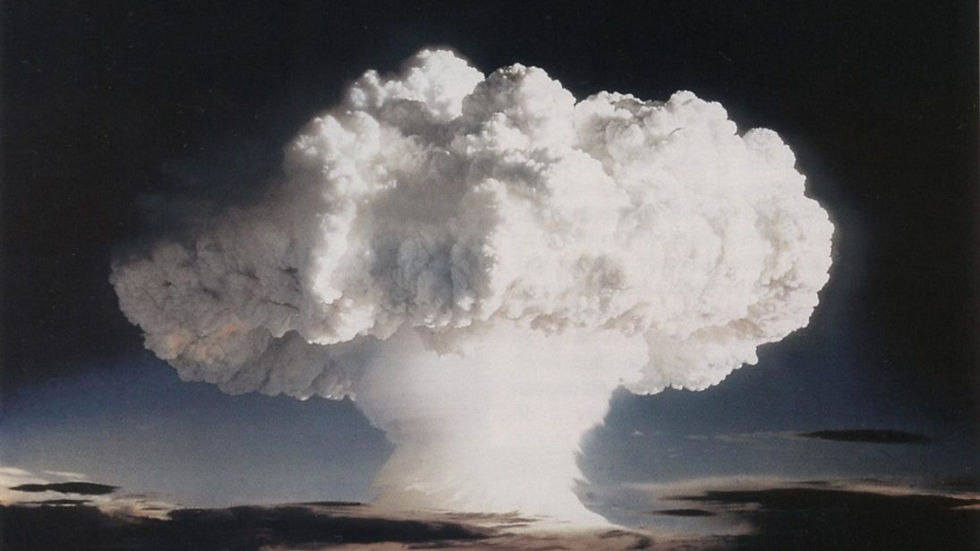
India and Pakistan Nuclear Tests (May 1998):
Bill Clinton Impeached (19th Dec 1998 - 12th Feb 1999):
Kosovo War (28th Feb 1998 - 11th June 1999):
Shared Themes - what do these periods have in common?


Comments